The Epistemic Audit: How Students Can Filter Real Information from AI Noise
Today’s students don’t struggle to find information—they struggle to trust it.
With AI tools, search engines, and social media producing endless explanations, summaries, and “facts,” the real challenge is figuring out what’s actually true. A well-written answer is no longer proof that it’s correct. In many cases, it just means it sounds convincing.
This creates a new kind of academic risk: not missing information, but absorbing misleading or low-quality information without realizing it.
To deal with this, students need more than general “critical thinking.” They need a repeatable system. This is where an epistemic audit comes in.
What Is an Epistemic Audit?
An epistemic audit is a step-by-step way to check how reliable a piece of information is—and how reliable your own thinking is when you evaluate it.
Instead of just asking, “Does this sound right?”, you ask:
- Where did this come from?
- What evidence supports it?
- Does the reasoning actually make sense?
- Am I biased toward believing this?
- How important is it that I get this right?
Think of it as a quality control system for your brain.
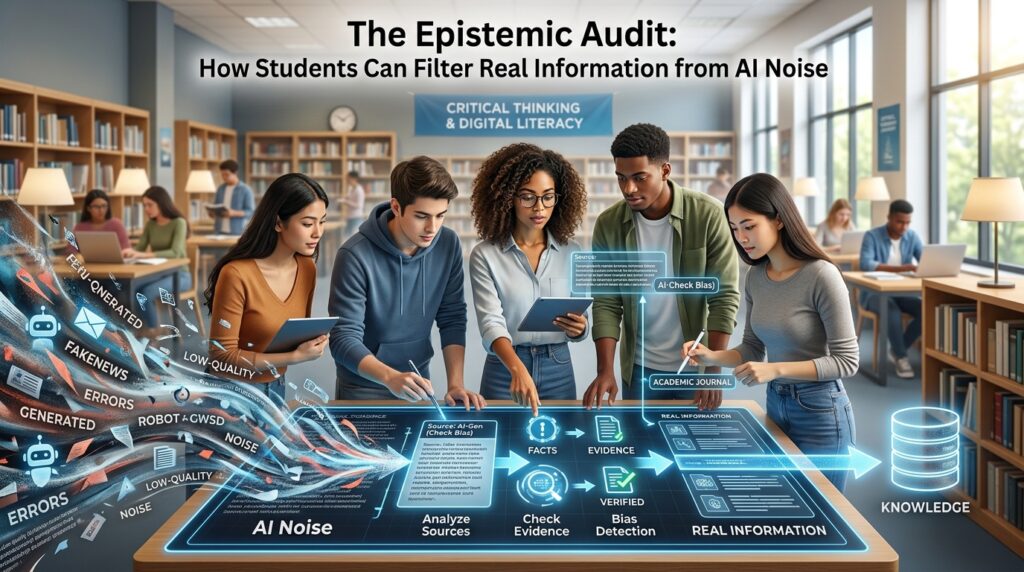
The 5-Step Student Version
1. Check the Source
Start simple: Where did this information come from?
- Is it from a textbook, a teacher, a peer-reviewed article, or just a random website?
- Is the author identified and credible?
- Is it original information, or a summary of something else?
Example: If you’re using an AI-generated explanation for a biology concept, remember that it may be summarizing multiple sources—and it could introduce mistakes along the way.
2. Look at the Evidence
Next, ask: What is this based on?
- Are there facts, data, or studies backing the claim?
- Or is it just stated confidently without proof?
- Can you find the same information in another reliable source?
A good rule: If you can’t confirm it somewhere else, treat it as uncertain.
3. Test the Logic
Even if the facts are correct, the conclusion might not be.
- Does the explanation actually connect the dots properly?
- Is it confusing correlation with causation?
- Are there missing steps in the reasoning?
Example: A study might show that students who study more get better grades—but that doesn’t mean studying more automatically guarantees success. Other factors matter too.
4. Check Your Own Bias
This is the part most students skip.
- Do you want this to be true because it supports your opinion?
- Are you trusting it because it’s easier than digging deeper?
- Are you accepting the first answer you see?
Example: If an AI tool gives you an answer that fits perfectly into your essay, you might accept it too quickly without verifying it.
5. Match Effort to Stakes
Not every piece of information needs the same level of checking.
- If it’s for a casual discussion, you can be flexible.
- If it’s for a major paper, exam, or project, you need stronger proof.
Ask yourself: What happens if this is wrong?
If the answer is “I lose points” or “I misunderstood a key concept,” it’s worth double-checking.
Why This Matters More Now
AI has changed how information works in three important ways:
- There is more content than ever before.
- It often sounds confident and polished, even when it’s wrong.
- It can mix correct and incorrect information in ways that are hard to spot.
This means you can’t rely on how something sounds. You have to rely on how it holds up under scrutiny.
A Quick Example
Imagine you’re writing a history paper and an AI tool tells you that a specific policy reduced unemployment by 30%.
Running a quick epistemic audit:
- Source: No clear origin.
- Evidence: No data or citation.
- Logic: No explanation of how the policy caused the change.
- Bias: You want this to be true because it supports your argument.
- Stakes: It’s going into a graded assignment.
Conclusion: You shouldn’t use it without verifying it from a reliable source.
Building the Habit
At first, this process might feel slow. But over time, it becomes automatic. You start spotting weak information faster and trusting strong information more confidently.
In school, this doesn’t just improve your grades—it improves how you think.
And in a world full of AI-generated answers, that’s a serious advantage.um fuga.